Rapunzel, Rapunzel, Let Down Your Hair: Rappelling Round Towers in Medieval Ireland

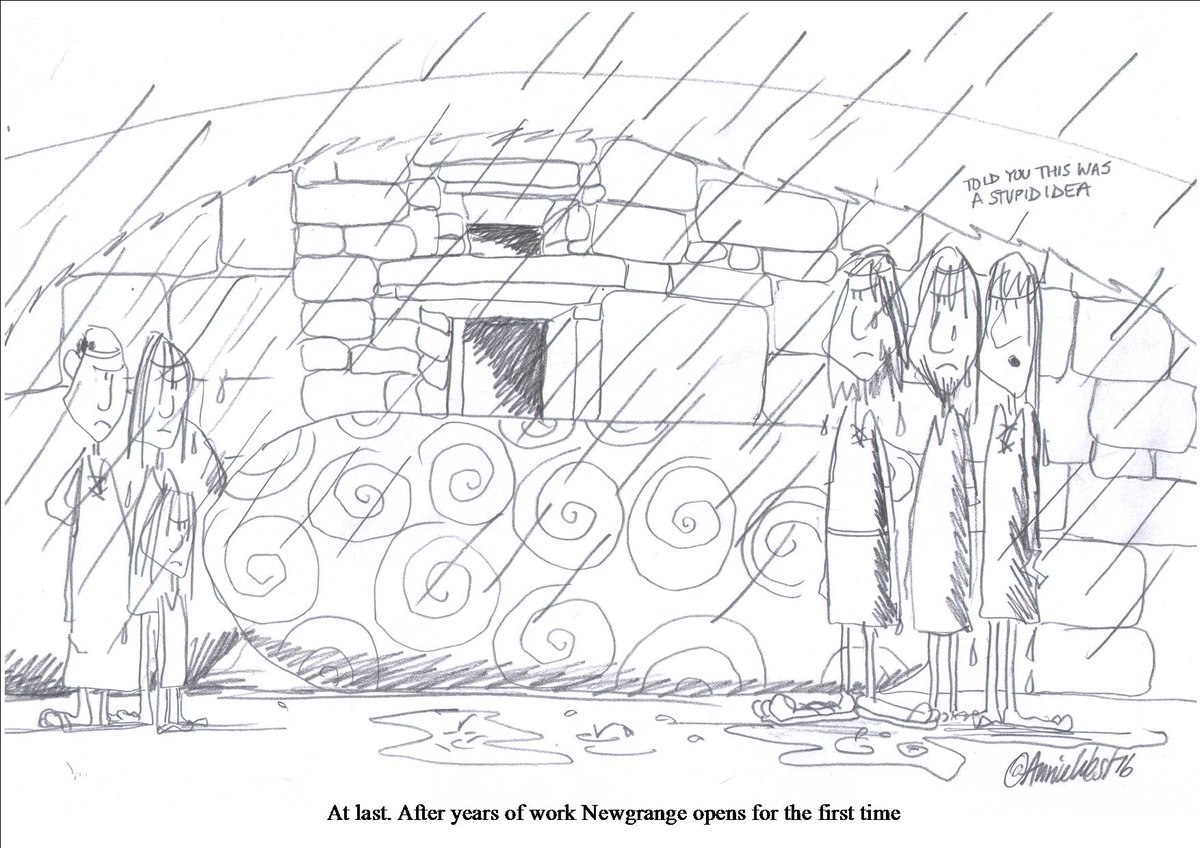
kells 253vThis is just a brief little ditty thrown together in haste -  in reply to a recent highly entertaining and thoughtful blog post by Robert M Chapple: ‘George and the Giant Archaeological Theory’. In it, he implies (somewhat alarmingly) that a) I am level-headed (slander, your honour!) and b) that I may somehow know something about monastic ‘rope-ladders’ in Ireland.

Sadly, I have yet to come across anything tangible involving rope ladders in either archaeology or hagiography, something which is only slightly lessened by my absolute devastation at the lack of early medieval pole vaulting evidence. (Confused? Read the original post.)

Continue reading

Posted in annotatiunculae | Tagged , , , , | 2 Comments

More Mugging of Monuments: Medieval Window Robbed from Church Island, Garadice Lough, Co. Leitrim

gara1

15th Century Window, Church Island, Leitrim (Image: P. Bradley)

Another week… and another theft of medieval archaeology. This time, a 15th century cusped ogee-headed window from the east wall of a medieval church ruin on Church Island, Garadice Lough, Co. Leitrim; in addition to a facing stone from a Bawn gun loop from Crane Island  in the same lake.

Its beginning to look like some sort of ‘medieval’ crime wave at this stage. One wonders what further bad news is in store for us around the country as national monuments staff go about their regular checks of isolated national monuments. The islands on Garadice Lough are close enough to the lakeshore and are on a popular boating/tourist route. Needless to say, the thefts would have entailed a vehicle, boat and several people. Once again, a deliberate and orchestrated theft of Irish archaeological & national heritage from everyone in the country. Continue reading

Posted in Archaeology | Tagged , , , , , , , | Leave a comment

‘Treasure Ireland’: On the Recent Recovery of Looted Irish Antiquities

Yaaaar, Me Hearties....

Image: Dunechaser – Flickr Commons/CC Licence

Fresh on the heels of last weeks shady shenanigans, today will see the display of 899 looted objects (the result of illegal metal-detecting) which have been recently recovered by the National Museum of Ireland. The details make for sobering reading. These are seemingly the results of just one individual, apparently operating within a single county, over a number of years.

What is particularly galling is something that may not immediately come across, i.e. the true extent of the damage done.     Continue reading

Posted in Archaeology | Tagged , , , , , | Leave a comment

On the Theft of a Decorated Medieval Font from Rathmore Church, Co. Meath

ertk2348

Church of St. Lawrence, Rathmore, Co Meath: Font
(TRIARC – Edwin Rae Collection)

Some worrying news: the recent theft of a medieval stone font  from the ruins of Rathmore Church, Co. Meath. The fifteenth century font (RMP ME024-017004-) is elaborately carved and takes the form of an octagonal shaft, c.2ft high, with figurative panels on each surface. It seems to have gone missing from Rathmore Church between April 16th and May 10th.

There has been a spate of thefts of medieval artefacts from Irish churches in recent times, but this marks an alarming new direction. Previous thefts involved metal artefacts/reliquaries and were presumably targeted for their metal content value; a rising trend across many parts of Europe given the  ongoing economic stagnation and sharp increase in metal prices.  The Rathmore theft is different. Being of stone, it does not carry an underlying ‘scrap’ value; and so presumably it has been deliberately targeted for other reasons (artistic, religious, financial). Continue reading

Posted in Archaeology | Tagged , , , , , | 2 Comments

OMG: Ogam in 3D – Exciting New Database from Dublin Institute for Advanced Studies

102107426_b3cd240e84

Ogham, Aghadoe, County Kerry.
Image: Jeremy Keith/Flickr Commons
(Used under a CC Licence)

A long-awaited and very exciting resource: the new online database ‘Ogham in 3D’ from Dublin Institute for Advanced Studies is coming shortly. Its already online with a small selection (50+) of individual stones. The site is going to offer 3D scans of Irish Ogham stones, alongside their associated historical, etymological and archaeological data; ‘bringing all of the available information together in a single searchable archive’.

In other words, a GOLDMINE for researchers. Really. You have no idea how disparate a lot of this information has previously been.

Ogham stones are crucial to understanding the development of Early Irish Christianity. Not only are the inscriptions the earliest recorded efforts at replicating the aural sounds of primitive Irish; but as formulaic monumental inscriptions involving named ancestral figures, they are quite possibly the earliest archaeological evidence for Insular Irish Christianity itself. Continue reading

Posted in Archaeology, Early Irish Christianity | Tagged , , , , , , , , , , , | 7 Comments

Blood from a Stone: some half drawn thoughts on Bullauns

IMAG1050_Sophia1_vox-hib

‘Blood from a stone’ (Image: Author)

A while back, I was sniffing around the site of an old medieval parish church in Kilnamanagh, Co. Roscommon (not much remains) when I caught sight of an old stone ‘stoup’, or font, placed into the surrounding graveyard wall. It’s not medieval, probably 18/19th cent, but it nevertheless reminded me of medieval bullaun stones; hemispherical cup-shaped depressions hollowed out of rocks and very much associated with medieval ecclesiastical sites and pilgrim routes.

The crucifix that had been placed inside was plastic and coated with metallic paint, probably a fragment from a temporary grave marker. Being there a while, the metal had obviously undergone some sort of rust/oxidation chemical process. As a result, the water within had turned a wonderful blood-red colour, resulting in a very evocative image.     Continue reading

Posted in Archaeology, Early Irish Christianity | Tagged , , , , , , , , | 4 Comments

Pre-Christian Rock and Roll: St. Patrick’s Chair, Boheh, Co. Mayo

Sophia1The townland of Boheh, Co. Mayo contains one of my favourite examples of outdoor prehistoric rock art in Ireland. Along a narrow side road, hidden away behind derelict housing and high hedgerows, lies a large natural outcrop of rock flecked with quartz strains, known as ‘St. Patrick’s Chair’. Upon its surface (spread out over 4 m2 ) over 250 individual petroglyphs are carved. They take the form of isolated ‘cup’, ‘cup and rings’ and ‘keyhole’ motifs (archaeological designations); and altogether form quite an impressive sight when viewed in the right seasonal and lighting conditions.

Today, April 18th, is one of those occasions.

Continue reading

Posted in Archaeology, Cult of Patrick | Tagged , , , , , , , , , , , , | Leave a comment

In the Name of Allah? Broaching Carolingian Connections at Ballycottin, Co. Cork

The British Museum’s Collection Database is a wonderful online resource containing over two million objects. It’s an incredible research tool in itself, for all periods and personages. Perhaps a lesser known aspect are some wonderful archaeological tidbits relating to finds from nineteenth century Ireland. Taking a virtual wander through the database one can stumble across some really intriguing objects, like this particular oddity from 1875; an early medieval Carolingian Brooch said to have been found in a bog at, or near, Ballycottin, Co. Cork.

AN00275809_001_l

Carolingian Brooch/Amulet (1875,1211.1) © The Trustees of the British Museum

Continue reading

Posted in annotatiunculae, Archaeology | Tagged , , , , , , , , , , , , | 5 Comments

Titillating Toponomy: Obscure Irish Placenames Explained

Image: heather__d (Flickr Commons / Used under a CC licence)

Image: heather__d (Flickr Commons / Used under a CC licence)

Every now and then one comes across certain Irish placenames that result in general titters and salacious sniggers because of their anglicised transliterations. A common misconception is that contemporary English placenames are, in some way, a reflection on their underlying meaning. Such a view is very much mistaken due to centuries of linguistic corruption and anglicization, and in actuality, serve to diminish the historical importance and underlying meanings attached to the original Irish rendering in question. Indeed, many of them can be shown to not only mean something entirely different, but to have at their core, ancient cultural and metaphorical significance. In order to rectify the matter; here’s the actual etymological and historical contexts behind some of the more titillating toponomic examples that occasionally do the rounds.

Continue reading

Posted in annotatiunculae, Placenames | Tagged , | 3 Comments

Vox Hiberionacum: Patrick and the Voicing of Early Irish Identity [Part 2]

(Continued from Part One…)

‘The Britains’ and the ‘Britons’ in Patricks Writings

In his writings Patrick makes it clear that as someone whose homeland was in ‘the Britains’, he not only considered himself a foreigner in Ireland, but also that the people he  lived among were, in turn, considered foreigners/strangers from a Roman perspective: inter barbaras itaque gentes habito proselitus et profuga, ‘I live among barbarian foreigners, as a stranger and exile’ (Epist 1); ubi nunc paruitas mea esse uidetur inter alienigenas, ‘It was among foreigners that it was seen how little I was’ (Conf 1); denique seruus sum in Christo genti exterae, ‘Now, in Christ, I am a slave of a foreign people’ (Epist 10).

Elsewhere, he refers to second generation Britons within Ireland in a manner which implies the maintenance of a distinct identity: et de genere nostro qui ibi nati sunt nescimus numerum eorum, ‘We do not know the number of our own people who were born there’ (Conf 42).  Taken in conjunction to his references to Roman Christian Gauls and pagan Franks, along with his stated desire to visit ecclesiastical brethren in ‘the Gauls’; it seems that Patrick conceived of both territories and peoples around him, at home and abroad, within a cognitive framework of multiple insular pluralities. For Patrick, cultural and territorial identities seem to have both co-existed with and contrasted against, certain religious identities under an umbrella of an idealised Christian version of Romanitas. Continue reading

Posted in Historical Patrick, Uncategorized | Tagged , , , | 2 Comments